Image Source: timesofindia.indiatimes.com
UPSC Mains GS I (2025)
Q. Examine the main aspects of Akbar’s religious syncretism.
(Answer in 150 words) 10 M
Introduction
Akbar (1556–1605) tried to unite people of different religions. His policy focused on tolerance, respect, and cultural mixing.
Body
Main aspects:
-
Removal of unequal taxes – ended jizya and pilgrim taxes on non-Muslims.
-
Sulh-i Kul (peace for all) – treated all religions equally.
-
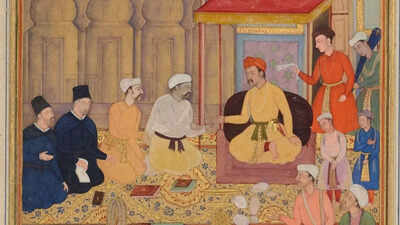
Ibadat Khana debates – scholars of Islam, Hinduism, Christianity, Jainism, and Zoroastrianism discussed religion.
-
Rajput alliances – gave high posts and married into their families.
-
Respect for customs – celebrated Hindu festivals and restricted cow slaughter.
-
Din-i Ilahi – his new faith blending ideas from many religions.
-
Art and culture – buildings and paintings reflected Indian-Persian mix.
Limitations
-
Din-i Ilahi had very few followers.
-
Orthodox Muslims resisted his policies.
-
Harmony depended on Akbar personally; weakened after his death.
-
Some policies were politically motivated, not purely religious.
Conclusion
Akbar promoted unity and reduced conflict, but long-term impact was limited.
Additional Information
Meaning of Syncretism
-
Syncretism refers to the blending or fusion of ideas, beliefs, or practices from different religions or cultures to create a unified system.
-
In the context of Akbar, it means his efforts to bring together elements of Hinduism, Islam, Jainism, Christianity, and Zoroastrianism to promote harmony and integration within his empire.
Historical Context of Akbar’s Religious Syncretism
-
Akbar ascended the Mughal throne in 1556 at the age of 13, inheriting a politically fragmented and religiously diverse empire.
-
The early Mughal rulers, including Babur and Humayun, were more orthodox, focusing mainly on Islamic traditions in governance.
-
Akbar faced rebellions and unrest, especially from Afghan nobles and some Rajput states, which made religious tolerance a practical necessity for political stability.
-
His personal curiosity about different faiths and exposure to scholars and administrators of various religions encouraged him to explore dialogue and mutual understanding.
-
The Ibadat Khana (House of Worship), established in 1575 at Fatehpur Sikri, became a space for interfaith discussions, reflecting his experimental approach to religious integration.
-
Alliances with Rajput rulers and their inclusion in administration influenced policies that were inclusive and respectful of Hindu customs and festivals.
-
This mix of pragmatism and personal openness formed the basis of his religious syncretism, which later included the creation of Din-i Ilahi, an eclectic spiritual code combining elements from multiple faiths.
Key Aspects of Akbar’s Religious Syncretism in Detail
-
Abolition of Discriminatory Taxes
-
In 1564, Akbar abolished the jizya, a tax levied on non-Muslims, and pilgrim taxes on Hindu and Jain devotees.
-
This helped gain the trust of Hindu communities, reduce resentment, and strengthen his base among the majority population.
-
He also reformed the tax system, standardizing revenue collection to avoid religious discrimination.
-
-
Sulh-i Kul (Universal Peace)
-
Sulh-i Kul was proclaimed around the 1570s as a guiding principle of governance, meaning absolute tolerance and equality of all faiths.
-
It extended to administrative appointments, law, and cultural patronage, ensuring no religion was favored in official matters.
-
-
Ibadat Khana and Interfaith Dialogues
-
Established in 1575 at Fatehpur Sikri, the Ibadat Khana hosted debates with scholars from Islam (Sunni, Shia), Hinduism (Vedantic scholars), Jainism, Zoroastrianism, and Christianity (Jesuit priests).
-
These debates influenced Akbar’s policies and led to synthesizing ideas of justice, morality, and ethical governance across traditions.
-
-
Integration of Rajputs
-
Akbar’s marital alliances included marrying Jodha Bai (Hindu Rajput princess).
-
Rajputs were appointed as mansabdars (military-administrative ranks), e.g., Raja Man Singh became one of his leading generals.
-
This political integration ensured loyalty of powerful Hindu clans and stabilized northern India.
-
-
Respect for Religious Customs
-
Court celebrated Diwali, Holi, and Eid, often with the emperor personally participating.
-
Akbar restricted cow slaughter in certain areas to respect Hindu sentiments.
-
Jain and Hindu scholars were consulted in state rituals and architectural projects.
-
-
Din-i Ilahi
-
Introduced around 1582, it blended Islamic monotheism, Hindu philosophy, Zoroastrian ethics, and personal moral codes.
-
Key followers included Raja Birbal, Todar Mal, and Abdul Rahim Khan-i-Khana.
-
Though largely limited to court nobles, it symbolized Akbar’s personal attempt to unite moral and spiritual ideas.
-
-
Cultural Fusion in Arts and Architecture
-
Fatehpur Sikri shows Islamic arches with Hindu motifs.
-
Mughal miniature painting under Akbar depicted court scenes, Hindu epics like Ramayana, and Persian influences.
-
Patronage of music, literature, and translation of Sanskrit texts (Mahabharata, Ramayana) into Persian fostered cross-cultural exchange.
-
Historians’ Views on Akbar’s Religious Syncretism
-
Abul Fazl (court historian)
-
Praised Akbar as a just and enlightened ruler who promoted universal tolerance.
-
Highlighted his efforts at interfaith dialogue and creation of Din-i Ilahi as evidence of his progressive outlook.
-
-
Badauni (contemporary orthodox scholar)
-
Criticized Akbar for departing from Islamic orthodoxy.
-
Viewed his religious experiments as undermining traditional Islamic law and favoring non-Muslims excessively.
-
-
Modern historians
-
Often interpret Akbar’s syncretism as pragmatic statecraft rather than purely spiritual idealism.
-
Emphasize that it helped integrate a diverse empire, strengthened political alliances, and fostered composite culture, but Din-i Ilahi had limited social impact.
-
Recognize Akbar’s policies as laying the foundation for India’s early secular ethos, blending political strategy with personal curiosity.
Legacy and Impact of Akbar’s Religious Syncretism
-
Political Stability and Integration
-
Policies of tolerance helped consolidate a vast, diverse empire.
-
Integration of Rajputs and other non-Muslim elites ensured loyalty, reduced rebellions, and stabilized frontier regions.
-
-
Promotion of Social Harmony
-
Equal treatment of all religions reduced sectarian tensions.
-
Non-Muslims felt a sense of inclusion in governance, promoting loyalty and cooperation.
-
-
Cultural and Intellectual Synthesis
-
Encouraged translation of Sanskrit texts into Persian (e.g., Mahabharata, Ramayana).
-
Fostered a composite culture reflected in music, painting, literature, and architecture.
-
Encouraged interfaith dialogue which influenced ethical and administrative ideas.
-
-
Religious Tolerance as a Precedent
-
Sulh-i Kul and Din-i Ilahi are early examples of secular governance in India.
-
Akbar’s approach became a symbol of inclusive rule, often cited by historians as a model for pluralistic administration.
-
-
Limitations and Short-Term Nature
-
Din-i Ilahi was limited to court nobles and had no mass appeal.
-
After Akbar, orthodox policies resurfaced under Jahangir and Aurangzeb, reducing the impact of his syncretism.
-
-
Modern Significance
-
His policies are studied as examples of early secularism and composite culture.
-
Inspire inclusive governance and interfaith dialogue in contemporary India.
Comments
Post a Comment