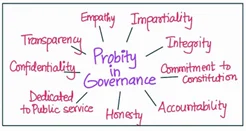
Image Source : pwonlyias.com
Case Study on Probity in Governance
Rajesh is a Group A officer with nine years of service. He is posted as an Administrative Officer in an Oil Public Sector Undertaking. As an Administrative Officer, he is responsible for managing and coordinating various administrative tasks to ensure the smooth functioning of the office. He also manages office supplies, equipment, etc.
Rajesh is now sufficiently senior and is expecting his next promotion to the Junior Administrative Grade (JAG) in the next one or two years. He knows that promotion is based on the examination of Annual Confidential Reports (ACRs)/Performance Appraisals of the last few years (about five years) by the Departmental Promotion Committee (DPC). An officer lacking the requisite grading in ACRs may not be found fit for promotion. The consequences of losing promotion may entail financial and reputational loss, as well as a setback in career progression. Although Rajesh puts his best efforts into the official discharge of his duties, he is unsure of the assessment by his superior officer. He is now putting in extra efforts so that he gets an excellent report at the end of the financial year.
As Administrative Officer, Rajesh regularly interacts with his immediate boss, who is his reporting officer for writing the ACR. One day, the boss calls Rajesh and asks him to buy computer-related stationery on priority from a particular vendor. Rajesh instructs his office to initiate action for procuring these items. During the day, the dealing Assistant brings an estimate of ₹35 lakhs covering all stationery items from the same vendor. It is noticed that, as per the delegated financial powers provided in the General Financial Rules (GFR) applicable to the organisation, expenditure for office items exceeding ₹30 lakhs requires the sanction of the next higher authority (the boss in the present case).
Rajesh knows that his immediate superior would expect these purchases to be cleared at his level and may not appreciate such "lack of initiative" on his part. During discussions with his office staff, he learns that the common practice of “splitting of expenditure” (where a large order is divided into a series of smaller ones) is followed to avoid obtaining sanction from the higher authority. This practice, however, is against the rules and may come to the adverse notice of Audit.
Rajesh is perturbed. He is unsure about the decision to take in this matter.
(a) What are the options available to Rajesh in the above situation?
(b) What are the ethical issues involved in this case?
(c) Which would be the most appropriate option for Rajesh, and why?
(Answer in 250 words)
Introduction
Civil servants often encounter ethical dilemmas where career aspirations and organisational practices clash with established rules. Rajesh’s case highlights the challenge of choosing between compliance with financial regulations and the pressure to satisfy superiors for favourable performance appraisals.
(a) Options Available to Rajesh
-
Follow the rules and place the file before the competent authority for sanction.
-
Split the order into smaller ones under ₹30 lakh, as per common but irregular practice.
-
Seek clarification from his boss by explaining the GFR restriction.
-
Escalate the issue to finance/vigilance if pressured to bypass rules.
-
Suggest phased procurement or renegotiation with the vendor to remain within limits.
(b) Ethical Issues Involved
-
Integrity vs. Expediency – whether to uphold rules or follow the shortcut of splitting orders.
-
Public Interest vs. Personal Career Interest – safeguarding public resources versus securing a good ACR.
-
Accountability vs. Organisational Culture – compliance with audit norms versus following prevalent irregular practices.
-
Rule of Law vs. Loyalty to Boss – adhering to GFR versus satisfying the superior’s expectations.
-
Transparency vs. Concealment – open sanction process versus hiding purchases through manipulation.
(c) Most Appropriate Option and Why
The most appropriate option is to follow the GFR provisions and obtain higher authority’s sanction. This ensures legal compliance, prevents audit objections, and upholds Rajesh’s integrity as a civil servant. By transparently explaining the rules to his superior, he demonstrates courage and professionalism. While this may invite short-term displeasure, in the long run it safeguards both institutional trust and Rajesh’s career credibility, aligning with the core values of public service.
Conclusion
Probity in governance demands that civil servants act as guardians of public resources. By choosing rule-based integrity over expedient shortcuts, Rajesh not only protects institutional accountability but also strengthens his own reputation as an ethical officer.
Additional Information
Standard Definitions related to the Case Study
-
Ethics – A set of standards that society places on itself to guide behaviour, choices, and actions of its members. (Second ARC: Ethics in Governance)
-
Integrity – Avoiding any obligation to individuals or organisations that might improperly influence one’s official duties. (Nolan Committee – Seven Principles of Public Life)
-
Probity – Adherence to robust ethical and moral norms such as honesty, rectitude, and uprightness within the governance process. (Second ARC: Ethics in Governance)
-
Accountability – The obligation to explain, justify, and accept responsibility for decisions and actions under appropriate scrutiny. (Nolan Principle)
-
Transparency – Openness and clarity of information regarding decisions and actions, with restrictions only when strongly justified by wider public interest. (Nolan Committee – Principle of Openness)
-
Conflict of Interest – A situation where private interests could improperly influence public duty, requiring disclosure and preventive mechanisms. (Second ARC, referencing OECD)
-
Objectivity – Decisions should be based on evidence and merit, free from bias, favouritism, or undue influence. (Nolan Committee – Principle of Objectivity)
-
Courage of Conviction – The ability to uphold principles and do what is right even in the face of opposition, pressure, or personal risk. (Second ARC: Ethics in Governance)
Comments
Post a Comment