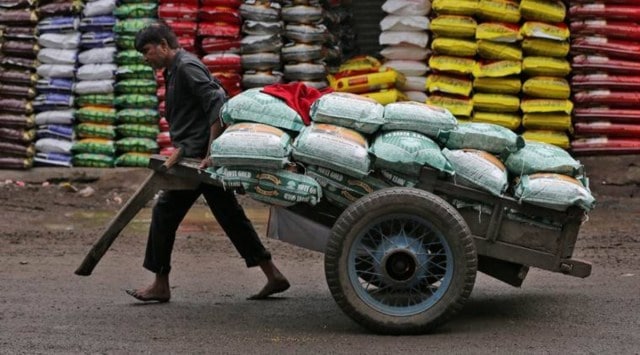
Image Source :The Indian Express
Introduction
India’s informal economy continues to dominate the labour market, accounting for nearly 83.5% of total employment according to the Periodic Labour Force Survey (PLFS) 2022–23. From agricultural labourers and construction workers to street vendors and platform-based gig workers, this sector supports millions but often lacks legal safeguards and access to social security.
In recent years, the emergence of platform-based work has added new dimensions to informality—offering flexibility but often without stable incomes or basic protections. In response, governments have begun to introduce regulatory measures. One such example is the Karnataka Platform-Based Gig Workers (Social Security and Welfare) Ordinance, 2025, which proposes a welfare cess. While well-intentioned, the ordinance has sparked debate over its design, especially the basis for calculating contributions and its alignment with national norms.
Historical Evolution and Types of India’s Informal Economy
The informal economy comprises economic activities that are not regulated or protected by the state. These include employment and enterprises that operate without formal registration, social security, or adherence to labor laws. Workers often lack written contracts, fixed wages, or institutional support, making them vulnerable to exploitation and economic shocks.
Types of Informal Employment
-
Self-employed individuals – petty traders, artisans, hawkers, and shopkeepers
-
Casual wage workers – daily laborers in agriculture, construction, etc.
-
Unprotected employees – contract workers within formal enterprises
-
Gig and platform workers – delivery agents, ride-hailing drivers, freelancers
Key Sectors
-
Agriculture – small farmers, seasonal farmhands
-
Construction – laborers, masons, painters
-
Retail and trade – vendors, small shop owners
-
Manufacturing – handloom, leather, food processing units
-
Transport – rickshaw pullers, auto drivers
-
Domestic work – household help, caregivers
-
Platform-based services – workers engaged via digital apps
Timeline: Evolution of Informality in India
🟫 Pre-Independence:
The Indian economy was largely agrarian and community-based. Colonial policies disrupted traditional livelihoods, displacing artisans and altering rural employment patterns, thereby laying early foundations for informal labor.
🟨 Post-Independence to 1970s:
India’s state-led industrialization did not create enough formal jobs to absorb the growing population. Informal employment persisted in agriculture and began expanding into urban centers through small-scale services and construction.
🟩 1980s–1990s:
Technological changes in agriculture and rising rural-urban migration increased informal work in urban areas. Informality also began to penetrate formal sectors through contract labor.
🟦 1991 Onward – Post-Liberalization Era:
Liberalization led to rapid economic growth but not corresponding formal employment. Subcontracting and outsourcing proliferated, and many formal enterprises began relying on informal labor.
🟥 2010s–Present:
Urban informal sectors diversified, and digital platforms introduced a new category of gig workers. The COVID-19 pandemic further exposed the precarity of informal employment, prompting renewed policy focus.
Current Factual Data on Informal Economy in India
🧑🏭 Employment Structure (PLFS 2022–23)
-
Self-employed workers: 57.3%
-
Casual labourers: 21.8%
-
Regular wage/salaried employees: 20.9%
-
Among these:
-
59% have no written job contract
-
54% are not eligible for any social security benefits
-
-
🏭 Sectoral Distribution of Workforce
-
Agriculture: 45.8%
-
Construction: 13.0%
-
Trade, hotel & restaurants: 12.2%
-
Manufacturing: 11.4%
📉 Unemployment Trends (PLFS 2022–23)
-
Overall unemployment rate: 3.2%
-
Urban unemployment: 5.4%
-
Youth unemployment (15–29 years): ~10%
🚀 Emerging Trends: Gig and Platform Economy
-
2020–21:
-
~7.7 million gig/platform workers
-
2.6% of non-agricultural employment
-
1.5% of total employment
-
-
Projections for 2029–30:
-
~23.5 million gig workers
-
6.7% of non-agricultural workforce
-
4.1% of total employment
-
-
Average earnings: ₹20,000 – ₹26,000/month
-
Prominent sectors:
-
Transport (ride-hailing, delivery)
-
Retail and logistics
-
On-demand services (e.g., repairs, cleaning)
-
Task-based micro-manufacturing
-
👩💼 Women in the Workforce
-
Labour Force Participation Rate (LFPR):
-
Increased from 23.3% (2017–18) to 41.7% (2023–24)
-
-
Worker Population Ratio (WPR):
-
Rose from 22% to 40.3%
-
-
Only 15.9% of employed women hold regular salaried jobs, most are in informal/self-employment
📈 Employment Growth & Formalization
-
Total employed workforce (2023–24): ~643 million
-
Up from 475 million in 2017–18 (increase of 17 crore jobs)
-
-
Formalization trend:
-
Over 7 crore workers formalized in the last 7 years (EPFO data)
-
-
Informal economy’s share in GDP: ~45% (2022–23)
-
Women in informal non-agri work: ~61%
Significance of Informal Workers
Informal workers form the backbone of India’s economy, contributing extensively across sectors without adequate recognition or protection. Their significance is multifaceted and foundational to national economic functioning:
1. Economic Contribution
-
Informal workers contribute significantly to GDP, especially through agriculture, construction, micro-manufacturing, and services.
-
Despite the lack of formal contracts or recognition, their labour ensures continuity in food production, urban development, and service delivery.
2. Employment Generation
-
The informal sector is the largest source of employment in India, especially for the unskilled, semi-skilled, and migrant populations.
-
It acts as a safety net, absorbing excess labour during economic downturns or after job losses in the formal sector.
3. Urban Infrastructure and Services
-
Informal workers—street vendors, domestic workers, delivery agents, waste pickers, etc.—keep cities functional, filling critical gaps in public services.
-
They contribute to the urban informal economy by supporting low-cost access to goods and services.
4. Rural Livelihoods and Agrarian Economy
-
In rural India, informal work is often the default mode of employment, especially in agriculture and allied activities.
-
It plays a key role in ensuring food security and maintaining rural consumption cycles.
5. Women’s Participation
-
A significant proportion of female workforce participation comes through informal employment—especially in sectors like home-based work, caregiving, and agriculture.
-
Informal work allows many women to combine income-earning with household responsibilities, though often at the cost of security and fair wages.
6. Flexibility and Entrepreneurial Space
-
Informal employment provides a low-barrier entry to economic activity, allowing individuals to start small businesses or engage in freelance labour.
-
It fosters micro-entrepreneurship, especially among marginalized communities.
Government Initiatives to Strengthen Informal Economy and Social Security
India has undertaken wide-ranging measures to formalize the informal economy and ensure social protection, particularly for vulnerable and gig workers. These initiatives span digital platforms, pension reforms, and sector-specific tracking mechanisms.
🔹 A. Central Government Initiatives
1. e-Shram Portal
-
Launched: 21st October 2021.
-
Objective: Centralized database for unorganized workers to access all government welfare schemes.
As of 2025, over 29 crore unorganised workers registered.
-
Enables workers to track entitlements, making benefits portable across states.
2. Pradhan Mantri Shram Yogi Maan-dhan (PM-SYM)
-
Launched: March 2019.
-
Pension scheme for unorganized workers aged 18–40 years with income below ₹15,000/month.
-
IIPA (2024 evaluation) recommended increasing income threshold to ₹18,000 and entry age to 50 years.
3. Atal Pension Yojana (APY)
-
Open to all unorganized workers.
-
Subscribers receive guaranteed monthly pensions (₹1,000–₹5,000) after 60 years.
-
Crossed 7 crore enrolments as of October 2024.
4. PM Street Vendor’s AtmaNirbhar Nidhi (PM SVANidhi)
-
Provides working capital loans (up to ₹50,000) for street vendors.
-
Over 60 lakh loans disbursed (as per MoHUA, 2024).
5. Pehchan Cards for Artisans
-
Identity and certification for handicraft workers under the “Vishwakarma” initiative.
-
Aims to include artisanal work within informal sector estimations.
6. Health Security – Ayushman Bharat
-
Free secondary and tertiary care up to ₹5 lakh.
-
Covers ~600 million Indians; benefits include many informal households.
7. Food Security – PMGKAY
-
Free foodgrain distribution to over 800 million people under National Food Security Act (NFSA).
-
Includes ration portability via One Nation One Ration Card (ONORC).
8. National Career Service (NCS) Portal
-
Job-matching and skill mapping for workers across sectors, including informal workers.
🔹 B. Data & Estimation Initiatives for Informal Sector
1. Annual Survey of Unincorporated Sector Enterprises (ASUSE)
-
Launched by MoSPI in 2021–22.
-
Tracks productivity, employment, and output of informal establishments.
2. Statistical Business Register (Under Development)
-
Digital registry to include informal enterprises across sectors.
3. Periodic Labour Force Survey (PLFS)
-
Provides quarterly and annual estimates of labour market indicators.
-
Used to track informal employment trends (including for women).
4. State Construction Welfare Boards & Industry Centres
-
Data sources for estimating informal employment in construction, tea, coffee, etc.
5. Gig Economy Inclusion
-
Ongoing efforts to map social influencers, UPI-based micro-enterprises, and platform-based gig work into national accounts.
🔹 C. Legal and Institutional Framework
The Indian government has established a robust legal and institutional setup to support the welfare and protection of informal workers. This includes constitutional mandates, labor codes, specific legislations, and digital platforms aimed at extending social security and labor rights.
1. Constitutional Provisions
-
Article 41: Directs the state to provide the right to work, education, and public assistance.
-
Article 42: Ensures just and humane conditions of work and maternity relief.
-
Article 43: Promotes living wages and decent working conditions for all workers, including informal ones.
2. Labour Codes (Enacted in 2020)
The four consolidated Labour Codes are:
-
Code on Wages
-
Code on Industrial Relations
-
Code on Social Security
-
Code on Occupational Safety, Health and Working Conditions (OSH)
Key provisions relevant to informal sector:
-
The Code on Social Security, 2020 includes gig, platform, and unorganised workers.
-
Mandates creation of a National Social Security Board for recommending welfare schemes.
-
Enables digital registration of informal workers via Aadhaar.
Worker Reskilling Fund introduced for retrenched workers.
States have pre-published draft rules; implementation awaited.
3. Key Legislations Prior to Labour Codes
-
Unorganised Workers’ Social Security Act, 2008: Provided for creation of welfare boards and schemes.
-
Building and Other Construction Workers (BOCW) Act, 1996: Focused on welfare, safety, and health of construction workers.
-
Inter-State Migrant Workmen Act, 1979: Regulated employment and working conditions of interstate migrants.
-
Minimum Wages Act, 1948: Ensured statutory minimum wages across sectors.
4. Digital and Institutional Infrastructure
-
National and State Social Security Boards: Set up to advise and monitor welfare schemes for unorganised workers.
-
Ministry of Labour and Employment (MoLE): Central authority responsible for policy-making and implementation of labor-related initiatives.
-
Integration with EPFO and ESIC: Institutional efforts underway to expand social security coverage to informal and gig workers.
5. Alignment with Global Commitments
-
India supports international frameworks like:
-
ILO Convention C102 (Social Security Minimum Standards)
-
ILO Convention C144 (Tripartite Consultation)
-
-
Aligned with SDG 1.3 (universal social protection) and SDG 8 (decent work and inclusive growth).
Case Study: Karnataka Gig Worker Ordinance
Significance
-
Important step for gig workers:
The Karnataka government has introduced a new law in 2025 to give basic social security (like health, accident, and retirement benefits) to gig and platform workers — for example, food delivery workers, cab drivers, and app-based service providers. -
Money for welfare benefits:
The law says companies like Zomato, Swiggy, Ola, etc., must pay a small fee (called cess) on each job done by a worker. This money goes into a welfare fund to support the workers. -
Covers many workers:
This law is expected to help lakhs of gig workers across Karnataka who are not covered by regular job benefits.
Issues
-
Fee (cess) based on worker’s payment, not company earnings:
The law says the fee should be 1% to 5% of what the company pays the worker. But this amount is often smaller than 1% of the company’s total income. National rules say companies must pay at least 1% of their total earnings. So, Karnataka’s rule may lead to lower money in the welfare fund. -
Likely to stay at lowest rate:
In the past, other welfare laws also said 1–2%, but most states collected only 1%. The same may happen here, meaning the fund may not get enough money. -
Some drivers may be left out:
In apps like Namma Yatri, drivers pay a monthly fee to use the app, and the full fare goes directly to them — the app doesn’t pay them per ride. Because there’s no payment from the app to the driver, this law might not cover them under the cess rule. -
Not matching central government rules:
The central government’s Social Security Code talks about cess on the company’s total income. Karnataka’s method (on worker payout) doesn’t fully match it, which might create confusion or conflict later.
Solutions
-
Use total fare or company income to decide fee:
The government could ask companies to pay cess based on total customer fare or their overall income, instead of only what they pay the worker. -
Cover all kinds of gig work models:
For platforms like Namma Yatri, the cess could be taken directly from the customer payment — for example, 2% of the ride amount. This would make sure drivers under all types of apps are covered. -
Different rules for different sectors:
Gig jobs are not all the same. Food delivery, cab driving, and beauty services work differently. The government can set different cess rates for each type. -
Follow central law to avoid problems:
Making Karnataka’s rules similar to the central law will help avoid confusion and make it easier for companies to follow both laws.
Challenges in India’s Informal Economy
India’s informal economy includes people who work without regular jobs, written contracts, or social security. This includes street vendors, construction workers, domestic helpers, gig workers, and small shop owners. Although informal workers make up a large part of India’s workforce, they face several major problems:
1. Lack of Social Security
-
Most informal workers don’t get benefits like pension, health insurance, paid leave, or accident protection.
-
If they fall sick, lose their job, or get old, there’s often no support system.
2. Low and Unstable Income
-
Their income is often very low and changes daily.
-
They are easily affected by price rise, illness, or poor weather (especially in agriculture and street vending).
3. No Job Protection
-
They can be removed from work anytime, without any notice or reason.
-
They don’t have any legal protection or formal complaints system.
4. Poor Working Conditions
-
Many informal workers work long hours in unsafe conditions.
-
For example, construction workers may not have helmets or safety gear, and sanitation workers often handle waste without protection.
5. Lack of Skill Development
-
Many workers learn skills informally but don’t have certificates to prove them.
-
This limits their chances of getting better-paying jobs or loans to grow a business.
6. Limited Access to Formal Credit
-
Because they don’t have proper income records or documents, banks often refuse to give them loans.
-
They are forced to borrow from moneylenders at high interest rates.
7. Exclusion from Digital Systems
-
Many informal workers don’t use smartphones or digital wallets.
-
As more welfare services shift online, they may get left out of schemes meant for them.
8. Lack of Reliable Data
-
Government often does not have clear or updated data on informal workers.
-
This makes it hard to design good welfare schemes or monitor their working conditions.
9. Weak Implementation of Laws
-
Even where laws exist to help informal workers (like Building and Construction Workers Act, Street Vendors Act), they are not fully enforced.
-
Workers often don’t know their rights or don’t trust the system.
10. Gender Disadvantages
-
Many women in the informal sector face dual burden: unpaid household work and poorly paid jobs.
-
They are often more vulnerable to harassment and discrimination.
Way Forward: Building a Stronger Informal Economy
To improve the lives of informal workers in India, we need to take several steps. These actions should focus on giving them dignity, safety, and security in their work.
1. Expand Social Security Coverage
-
Provide health insurance, accident cover, pension, and maternity benefits to all informal workers.
-
Ensure easy registration on platforms like e-Shram, and link it with welfare schemes like PM-SYM, Ayushman Bharat, and ESIC.
2. Ensure Minimum Income and Job Security
-
Introduce a national minimum wage that applies to informal workers across sectors.
-
Encourage long-term contracts or consistent work opportunities where possible.
3. Improve Working Conditions
-
Enforce safety standards, especially in construction, waste management, and domestic work.
-
Provide access to clean drinking water, toilets, and rest areas at work sites.
4. Recognise and Formalise Work
-
Give legal recognition to workers like street vendors, gig workers, and home-based workers.
-
Provide identity cards, licenses, and support for running their businesses legally.
5. Skill Development and Certification
-
Offer training programs that match the current needs of the economy.
-
Give skill certificates so that informal workers can get better job offers or start their own businesses.
6. Easy Access to Credit and Digital Payments
-
Simplify loan processes through banks and cooperative societies.
-
Provide financial literacy and digital training so workers can use online payments and save money safely.
7. Data Collection and Monitoring
-
Conduct regular surveys to understand the size and needs of the informal sector.
-
Use this data to design and monitor policies better.
8. Local Government and Worker Participation
-
Involve local bodies (like Panchayats and Urban Local Bodies) in identifying, registering, and supporting informal workers.
-
Encourage formation of worker collectives, SHGs, or unions to raise collective demands.
9. Gender-Sensitive Reforms
-
Design schemes that especially support women workers with child care support, safe workspaces, and equal pay.
10. Better Implementation of Laws and Welfare Boards
-
Ensure full implementation of existing laws like the Street Vendors Act, Building Workers Act, and Labour Codes.
-
Strengthen welfare boards with proper funding and monitoring systems.
Conclusion
Many countries have taken stronger steps than India to protect informal and gig workers. Spain’s Riders' Law (2021) recognized app-based delivery workers as regular employees, giving them access to minimum wages, social security, and job protection. Uruguay has a well-developed social security system that covers health and pensions for most workers. Thailand has extended at least one form of social protection to about 61% of its population, which is higher than the average in Southeast Asia.
In contrast, India, despite covering around 64% of its population under at least one social protection scheme (as of 2025), still faces key gaps in enforcement, awareness, and coverage for many informal workers. India ranks 116 out of 174 countries in the World Bank’s Human Capital Index, reflecting challenges in health, education, and worker productivity.
Global trends show that countries with stronger social protection systems experience better outcomes in health, income equality, and development. The ILO’s Social Protection Report and data from OECD countries highlight how comprehensive coverage, effective labour laws, and inclusive policies contribute to more resilient and equitable economies.
To close the gap, India must work toward building a more inclusive and effective safety net that protects all workers—especially those in the informal sector.
Comments
Post a Comment