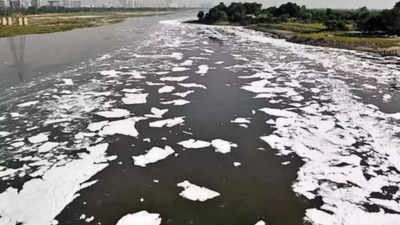
Credit: The Times Of India
Introduction
Once a river of pristine blue waters, the Yamuna is now one of the most polluted rivers in the world, especially in its downstream stretches through Delhi, which dumps nearly 58% of its waste into it. Despite being considered sacred and vital to the region’s ecology and society, the Yamuna is now referred to as “Delhi’s dying holy river.”
Flowing across seven states, the Yamuna is the longest tributary of India and the second-largest tributary of the Ganga. Originating from the Yamunotri glacier in Uttarakhand, it merges with the Ganga at the Sangam in Prayagraj, Uttar Pradesh.
Religious and Socioeconomic Significance
-
Religious Significance:
Worshipped as Goddess Yamuna in Hinduism, she is considered the daughter of the Sun and sister of Yama, the God of Death. Bathing in the river’s waters is believed to absolve sins, and last rites are performed on its banks. -
Socioeconomic Significance:
With an annual flow of about 10,000 billion cubic metres, the Yamuna irrigates fertile Indo-Gangetic plains and provides over 70% of Delhi’s water supply. Nearly 57 million people depend on it for drinking, agriculture, and industry.
Current Status: What the Data Says
According to a July 2025 report by the Delhi Pollution Control Committee (DPCC):
-
Faecal coliform bacteria were found at levels up to 92 million MPN/100 ml, over 36,000 times the ideal bathing limit (500 MPN/100 ml).
-
Biochemical Oxygen Demand (BOD), which indicates organic pollution, rose to 51 mg/l (safe limit: ≤ 3 mg/l).
-
Dissolved Oxygen (DO), necessary for aquatic life, dropped to 0 or near 0 across several locations (safe limit: ≥ 5 mg/l).
Definitions: Understanding the Parameters
-
BOD (Biochemical Oxygen Demand):
Measures oxygen needed by microbes to decompose organic matter. High BOD = more pollution from sewage. -
DO (Dissolved Oxygen):
Amount of oxygen available for aquatic life. Low DO suffocates aquatic organisms. -
Faecal Coliform:
Bacteria from fecal waste. High levels indicate serious sewage contamination and pose major health risks.
Major Sources of Pollution
1. Domestic Wastewater (90% of Pollution Load)
According to CPCB-DPCC reports, 90% of Delhi’s domestic wastewater flows directly into the Yamuna, primarily due to:
-
Discharge from household activities, rich in detergents, phosphates, and chemicals.
-
Phosphate levels recorded at 0.51 mg/litre — 10 times higher than safe limits — creating toxic froth layers on the river.
2. Industrial Heavy Metal Contamination
-
Najafgarh and Shahdara drains, Delhi’s largest, carry high loads of industrial and chemical waste.
-
Heavy metals like Iron (Fe) have been found in concentrations exceeding safe limits, threatening both human and ecosystem health.
-
Effects include organ damage, developmental disorders, and nervous system damage.
-
3. Untreated and Partially Treated Sewage
-
Over 800 million litres/day of mostly untreated sewage enter the Yamuna, along with 44 million litres/day of industrial effluents.
-
Only 35% of the sewage is properly treated.
-
Sewage Treatment Plants (STPs) often fail due to power cuts, mechanical faults, or poor maintenance.
4. Idol Immersion During Festivals
-
Idols made from plaster of Paris and toxic paints release heavy metals like lead, chromium, and iron.
-
After immersion:
-
Chromium levels increased 11 times (0.05 mg/L limit).
-
Iron levels rose 71 times (0.3 mg/L limit).
-
-
These toxins enter the food chain, especially through vegetables grown on floodplains.
5. Plastic Pollution
-
Delhi generates ~2.5 lakh tonnes of plastic annually; 50% is single-use.
-
Plastic waste, from flip-flops to food packaging, lines the riverbanks and often ends up in the Yamuna.
-
Plastic enters the river mainly through open drains used by the public to dump waste.
Impact of COVID-19 Lockdown on Yamuna
During the COVID-19 lockdown, images of a visibly cleaner Yamuna went viral. However, the real pollution load — 80–90% — comes from domestic sewage, not industry (which contributes only 10–20%).
-
With households still generating waste, there was no significant reduction in pollution.
-
Also, no real-time scientific data exists to conclusively show improvements in water quality due to the lockdown.
Effects of Yamuna Pollution
A. Environmental Impact
-
Loss of Aquatic Life: Low levels of dissolved oxygen (DO) and high biochemical oxygen demand (BOD) make the water uninhabitable for many aquatic organisms, leading to the death of fish and other species.
-
Ecosystem Imbalance: Toxic pollutants disrupt the delicate ecological balance, affecting flora and fauna dependent on the river ecosystem.
-
Eutrophication: Excess nutrients from untreated sewage and industrial waste promote algal blooms, which deplete oxygen and create "dead zones" in the river.
B. Public Health Hazards
-
Waterborne Diseases: High levels of faecal coliforms indicate the presence of pathogens that cause diseases like cholera, dysentery, typhoid, and hepatitis.
-
Toxic Exposure: Heavy metals and industrial chemicals in the water can lead to long-term health issues, including skin diseases, respiratory problems, and cancer.
-
Contaminated Drinking Water: Since Yamuna supplies over 70% of Delhi’s water, inadequate treatment risks contaminated water reaching households.
C. Socioeconomic Consequences
-
Loss of Livelihood: Fishermen and farmers who rely on the river face reduced income due to declining fish populations and degraded soil quality.
-
Reduced Tourism & Religious Activities: The sacred and aesthetic value of the river is diminished, impacting tourism, pilgrimage, and cultural ceremonies.
-
Increased Treatment Costs: More polluted water requires more energy and investment for purification, burdening municipal and state resources.
D. Agricultural Impact
-
Soil Degradation: Polluted river water used for irrigation can deposit heavy metals and toxins in agricultural land, reducing fertility and crop quality.
-
Food Contamination: Crops irrigated with polluted water may carry harmful residues, entering the food chain and affecting consumer health.
Governmental Efforts for Yamuna Rejuvenation
🌀 Yamuna Action Plan (YAP)
An Indo-Japanese initiative under the National River Conservation Directorate (NRCD):
📍 Phase I (1993–2003)
-
Built 29 STPs, 58 pumping stations, 179 km sewer lines
-
Created public toilets, crematoria, and initiated riverfront development
-
750 MLD treatment capacity added
📍 Phase II (2004–2011)
-
Focused on non-sewerage components, public awareness, pilot projects, slum rehabilitation
-
189 MLD of new STP capacity approved
-
Budget: ₹624 crores
📍 Phase III (2018 onwards)
-
Integrated into the National Mission for Clean Ganga (NMCG)
-
Major STP and sewerage projects in Kondli, Rithala, Okhla zones
🚿 Yamuna Purification Drive (2018)
By Public Health Department, covering:
-
Towns like Gurgaon, Karnal, Panipat, etc.
-
11 treatment plants constructed
-
Gurgaon STP reduced BOD from 200 mg/l to 30 mg/l
🏛️ High-Level Review Meeting (2025)
Chaired by Union Home Minister Amit Shah
Key Decisions:
-
Increase STP capacity to 1500 MGD by 2028
-
Drone survey of Najafgarh and Shahdara drains
-
Improve BOD levels in key drains
-
Treated water from Okhla STP to be released downstream
-
Third-party quality testing of all STP outflows
-
Conduct detailed survey of Delhi’s household water supply
-
Rainwater harvesting through reservoirs (also to promote tourism)
-
Collaborate with NDDB for dairy and cow shelter waste management
-
Regularize borewells, prevent uncontrolled extraction
-
Delhi Pollution Control Committee (DPCC) to act urgently on water pollution
-
Inter-state coordination (Delhi, Haryana, Uttar Pradesh) for collective clean-up efforts
Community Efforts
While government action is critical, the active involvement of communities can greatly accelerate the Yamuna’s revival:
-
Monitoring and Reporting: Locals can help authorities by reporting ground realities and checking illegal effluent discharge from industries.
-
Training and Awareness: Community-level programs can educate citizens about sewage system maintenance and responsible waste disposal.
-
Livelihood from Waste: A localized waste management system that encourages recycling and upcycling can create employment and reduce dumping.
-
Rainwater Harvesting: Promoting harvesting techniques helps secure uncontaminated water for domestic needs year-round.
-
Literacy and Awareness: A direct correlation exists between higher literacy rates and better river water quality. Educating the masses is a long-term solution.
-
Eco-Friendly Celebrations: Communities can adopt environmentally friendly alternatives to idols and offerings, using biodegradable and organic materials.
Conclusion
The Yamuna is not just a river; it is a lifeline, a symbol of heritage, and a spiritual cornerstone for millions. However, its present condition is a stark reminder of the environmental cost of unplanned urbanization and policy neglect. Government initiatives—from YAP to STP upgradation and inter-ministerial coordination—reflect a renewed urgency to reverse the damage. However, long-term success lies not just in infrastructure but in community participation, behavioral change, and strict enforcement of environmental laws. Reviving Yamuna is no longer a choice—it is a necessity for ecological balance, public health, and cultural survival.
Comments
Post a Comment