Introduction
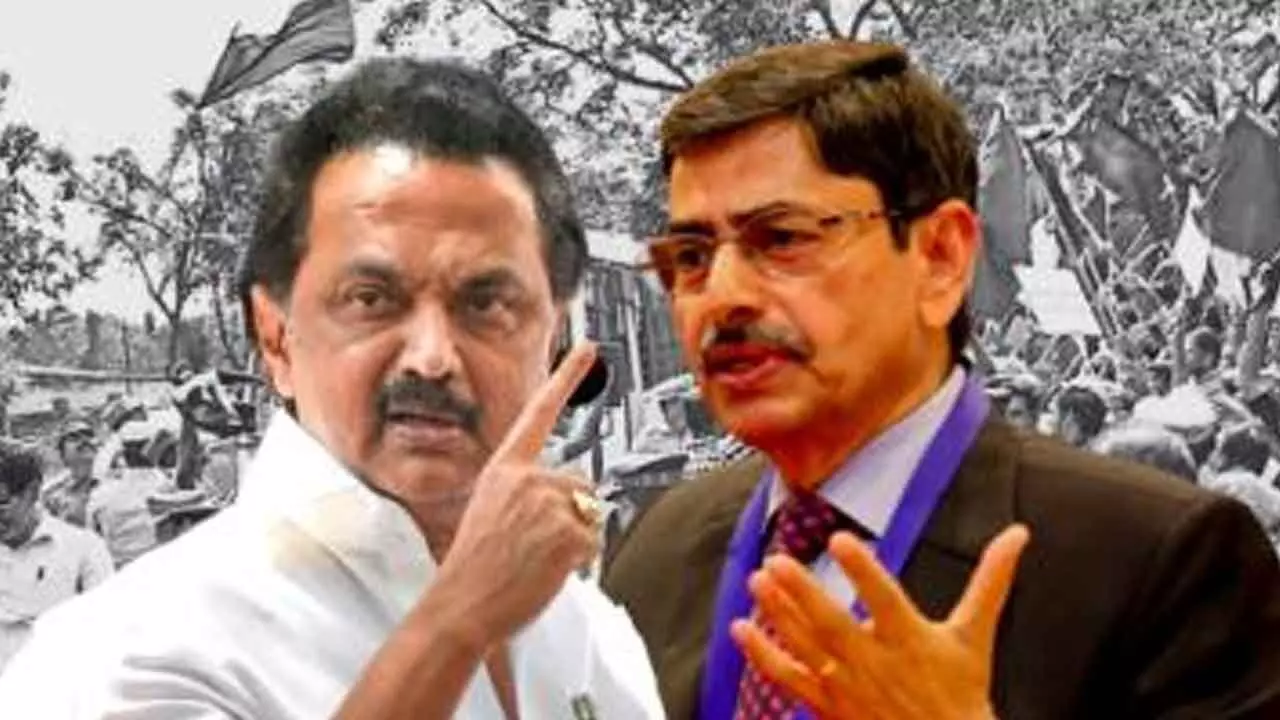
The office of the Governor, envisioned as a neutral constitutional authority, has increasingly found itself at the center of political and legal confrontations. Recent high-profile tussles between Governors and state governments — particularly in Tamil Nadu, Kerala, Maharashtra, West Bengal, and Punjab — have reignited debates on the limits of the Governor’s power, discretion, and accountability. The Supreme Court’s April 2025 verdict in State of Tamil Nadu vs. Governor of Tamil Nadu marks a significant moment in this ongoing debate, reasserting democratic and federal principles in governance.
Body
1. Background and Evolution of the Governor's Office
-
Colonial Legacy: Introduced under the 1858 Government of India Act.
-
Government of India Act, 1935: Governors held discretionary powers as agents of the Crown.
-
Post-Independence Reforms:
-
Draft Constitution proposed elected Governors but this was dropped.
-
Dr. Ambedkar clarified that the Governor must act on the advice of the Council of Ministers.
-
The model of nomination (not election) was adopted from Canada, emphasizing neutrality and unity.
-
2. Constitutional Powers of the Governor
-
Executive Powers:
-
Appointment of Chief Minister and Ministers (Art. 164), and state officials.
-
Power to seek information from the Chief Minister (Art. 167).
-
-
Legislative Powers:
-
Summons and prorogues State Legislature (Art. 174).
-
Assents to Bills, returns, withholds, or reserves them (Art. 200).
-
Can promulgate ordinances when Assembly is not in session (Art. 213).
-
-
Financial Powers:
-
Money Bills can be introduced only with the Governor’s recommendation (Art. 202).
-
Controls the State Contingency Fund (Art. 267).
-
-
Judicial Powers:
-
Can grant pardons, reprieves, and commute sentences under Article 161 (except for death penalty).
-
-
Discretionary Powers:
-
Reserving Bills for the President (Art. 200, 201).
-
Recommending President’s Rule (Art. 356).
-
-
Legal Immunity:
-
Article 361 provides immunity from criminal proceedings while in office.
-
3. Significance of the Governor’s Office
Despite recent controversies, the Governor’s office plays a vital role in India’s constitutional framework:
-
Constitutional Balance: Acts as a link between Centre and State, ensuring compliance with constitutional principles.
-
Legislative Order: Enables smooth transition of power, validates legislative work, and ensures parliamentary functioning.
-
Administrative Stability: Provides continuity, especially in times of political uncertainty.
-
Tribal and Minority Protection: Oversees special responsibilities in tribal areas under the Sixth Schedule.
-
Higher Education: Serves as Chancellor of state universities and makes key academic appointments.
4. Ongoing Tussles Between Governors and State Governments
-
Tamil Nadu:
-
Governor delayed assent to 10 Bills, and after re-enactment, forwarded them to the President.
-
The Supreme Court ruled this unconstitutional and used Article 142 to treat the Bills as law.
-
-
Kerala:
-
Governor withheld assent to multiple Bills and unilaterally installed “Bharat Mata” portraits in official functions.
-
The state filed a petition in SC but withdrew it citing the Tamil Nadu ruling.
-
-
Maharashtra:
-
In 2019, the Governor invited a minority BJP government, which collapsed in 80 hours.
-
CM’s nomination was allegedly bypassed without due consultation.
-
-
West Bengal:
-
Repeated friction due to Governor’s public statements and delay in assent to Bills.
-
-
Punjab:
-
Refusal to summon Assembly sessions against the advice of the Cabinet.
-
5. Effects on Federalism
-
Undermines Legislative Autonomy: Delays in assent diminish the role of elected Assemblies.
-
Disrupts Governance: Critical policies and decisions are held hostage to procedural delays.
-
Centre-State Distrust: Governors are increasingly viewed as representatives of the Union rather than neutral constitutional heads.
-
Democratic Erosion: When unelected authorities override the will of elected governments, it weakens democratic accountability.
6. Key Supreme Court Verdicts and Doctrines
-
State of Tamil Nadu vs. Governor (2025):
-
Governor cannot reserve re-enacted Bills for Presidential consideration.
-
Assent or withholding is mandatory after reconsideration by the Assembly.
-
Court invoked Article 142 to declare the Bills as law.
-
Declared Presidential action invalid as referral was unconstitutional.
Governor Must Act in ‘Reasonable Time’
Governor’s Delay Unconstitutional
-
-
Shamsher Singh v. State of Punjab (1974):
-
Governor must act on the advice of the Council of Ministers except in narrowly defined cases.
-
-
Nabam Rebia v. Deputy Speaker (2016):
-
Reaffirmed that the Governor cannot act on their own discretion in routine matters.
-
-
S. R. Bommai Case (1994):
-
Limited the misuse of Article 356 and emphasized floor tests for confidence motions.
-
7. Way Forward: Reforms and Recommendations
✅ Legal and Constitutional Reforms
-
Codify Time Limits: Amend the Constitution or pass laws mandating that Governors decide on Bills within 30–60 days.
-
Limit Discretion: Clearly define circumstances where the Governor may withhold or reserve a Bill.
-
Ensure Transparency: Require Governors to provide written reasons for rejecting or withholding assent.
✅ Structural Reforms
-
Appointment Mechanism:
-
As per Venkatachaliah Commission: A collegium comprising PM, HM, Lok Sabha Speaker, and State CM should appoint Governors.
-
-
Fixed Tenure:
-
Ensure a 5-year term with removal only for proven incapacity or misconduct.
-
-
Mandatory Consultation with CM:
-
Recommended by Sarkaria and Punchhi Commissions to strengthen state input.
-
✅ Institutional Safeguards
-
Floor Test on Assembly Floor:
-
Mandate that any doubt regarding majority must be resolved via floor test.
-
-
Cultural Neutrality:
-
Governors must not impose ideological symbols in official functions.
-
-
Judicial Review of Inaction:
-
SC must have clear guidelines to intervene when Governors act arbitrarily or remain inactive.
-
Conclusion
The recent escalation of tensions between Governors and state governments has exposed gaps in India’s federal setup and constitutional practice. While the Governor is intended to act as a neutral bridge between the Union and the States, repeated instances of overreach threaten democratic governance and cooperative federalism. The Supreme Court’s landmark verdict in the Tamil Nadu case reaffirmed the constitutional limits of the Governor’s office and highlighted the need for urgent reforms. Moving forward, it is imperative that Governors act as facilitators — not disruptors — of constitutional governance, respecting the will of elected governments while upholding constitutional integrity.
Comments
Post a Comment