Introduction
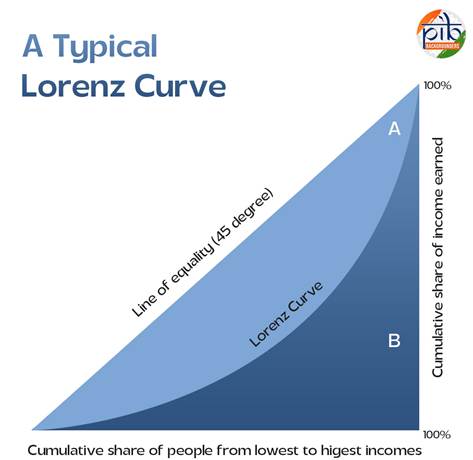
Recent claims suggesting that India is one of the most equal countries in the world have sparked considerable debate. Based on the World Bank’s 2022–23 Poverty and Equity Brief, India’s Gini Index—a measure of inequality—was reported at 25.5, placing it 4th globally in terms of equality. While this has been presented as a major achievement, several economists and policy analysts have questioned the methodology, interpretation, and comparability of the data used. This situation provides an opportunity to examine not just the statistical indicators, but also the broader socio-economic context shaping inequality in India today.
Body
1. Data in the World Bank Report
According to the World Bank:
-
India’s Gini Index, derived from consumption expenditure data, declined from 28.8 in 2011–12 to 25.5 in 2022–23, placing it among the most equal societies globally.
-
The share of people living in extreme poverty (defined as living on less than $2.15/day) reduced sharply from 16.2% in 2011–12 to 2.3% in 2022–23.
-
Under the revised global poverty threshold of $3/day, the poverty rate for 2022–23 is estimated at 5.3%.
-
An estimated 171 million people were lifted out of extreme poverty between 2011 and 2023.
2. Government Claims and Welfare Initiatives
These improvements have been attributed to a range of policy measures aimed at improving financial inclusion, welfare delivery, and access to basic services:
-
Jan Dhan Yojana: Over 55 crore bank accounts opened to enable direct benefit transfers and financial access.
-
Aadhaar and DBT: Streamlined delivery of subsidies and welfare benefits, with reported savings of over ₹3.48 lakh crore.
-
Ayushman Bharat: Provided healthcare access to over 41 crore people, supported by digital health records and empanelled hospitals.
-
Stand-Up India and PM Vishwakarma: Promoted entrepreneurship among marginalized groups through loans and support services.
-
Free food grain schemes: Continued distribution of essential food items through public distribution channels, covering over 80 crore beneficiaries.
These initiatives are credited with reducing disparities in consumption and expanding access to essential services.
3. Criticisms and Methodological Concerns
Despite optimistic interpretations, experts have flagged major concerns about the validity of India’s equality claims:
(a) Consumption vs. Income Data
India’s Gini score is based on consumption surveys, while most countries use income data.
Since high-income groups save more, consumption appears more equal than income.
Cross-country comparisons using different bases lead to misleading conclusions.
(b) Persistent Low Consumption Inequality
India’s consumption inequality has remained low since the 1970s (Gini ~0.25–0.30).
Government schemes like free food and cash transfers may narrow consumption gaps, but don’t reduce income or wealth inequality.
(c) Rising Income and Wealth Concentration
A 2024–25 study shows:
Top 1% earn 22.6% of total income, among the highest globally.
They hold 40.1% of national wealth, up from 12.5% in 1980.
Top 0.001% (≈10,000 people) hold 3× the wealth of the bottom 50%.
This reflects a sharp rise in economic concentration at the top.
(d) Market Power and Job Challenges
Post-2015, a few large corporates gained dominance across sectors.
This led to reduced competition, declining firm entry, and rising mark-ups (from 1.45 to 1.7 between 2013–2020).
Manufacturing’s share in jobs and GDP fell, with employment mostly growing in the informal sector.
(e) Growth Comparison: 2004–2014 vs. 2015–2024
GDP Growth fell from ~7–8% to 5.8% per year.
Investment dropped from 32–38% of GDP to 26–32%.
Job creation slowed, especially in non-farm sectors.
Real wages rose until 2015 but later stagnated.
Consumption and poverty reduction weakened post-2015.
The earlier period witnessed inclusive, broad-based growth; recent years show K-shaped growth, benefitting mainly the upper-income groups.
4. Way Forward
To address both the statistical confusion and real inequalities, the following steps are suggested:
-
Improve data transparency and comparability: Ensure that income and consumption data are clearly differentiated and avoid misleading comparisons across different methodologies.
-
Enhance income and wealth data collection: Incorporate tax records, national accounts, and surveys that capture top-end income and wealth.
-
Strengthen progressive taxation: Consider wealth and inheritance taxes to fund public investment in health, education, and nutrition.
-
Promote inclusive job creation: Boost employment in manufacturing and construction, especially in the formal sector.
-
Ensure fair market practices: Curb excessive market concentration and encourage competition through regulatory reform.
-
Expand social spending: Public investment in human capital should be significantly increased to build long-term economic resilience.
Conclusion
India’s recent claim of being one of the most equal countries globally is based on limited and specific indicators, namely consumption inequality. While it reflects certain positive outcomes of welfare initiatives, it does not capture the full picture of income, wealth, or structural inequality. The gap between rich and poor, in terms of income, assets, and opportunity, continues to widen—evident in data on job stagnation, wage trends, and wealth concentration.
Going forward, evidence-based policymaking, grounded in robust and transparent data, is essential for addressing inequality meaningfully. Equality should be more than a statistical achievement—it must translate into genuine improvements in people’s lives across all sections of society.
Comments
Post a Comment