The Shakambari festival at Kanaka Durga Temple in
Vijayawada brings into focus India's rich tradition of temple architecture.
Among the most significant contributions to this heritage are the Dravidian
style of South India and the Chalukyan style of the Deccan region. These
architectural traditions, developed between the 6th and 16th centuries,
represent not just places of worship but also the technological, artistic, and
cultural zenith of their eras.
Dravidian Temple Architecture
Historical Context and Development
The Dravidian style flourished under three major
dynasties:
- Pallavas
(6th–9th century CE): Pioneers who
transitioned from rock-cut to structural temples
- Cholas
(9th–13th century CE): Perfected the style with
monumental structures
- Vijayanagara
Empire (14th–16th century CE): Added
elaborate pillared halls and enclosures
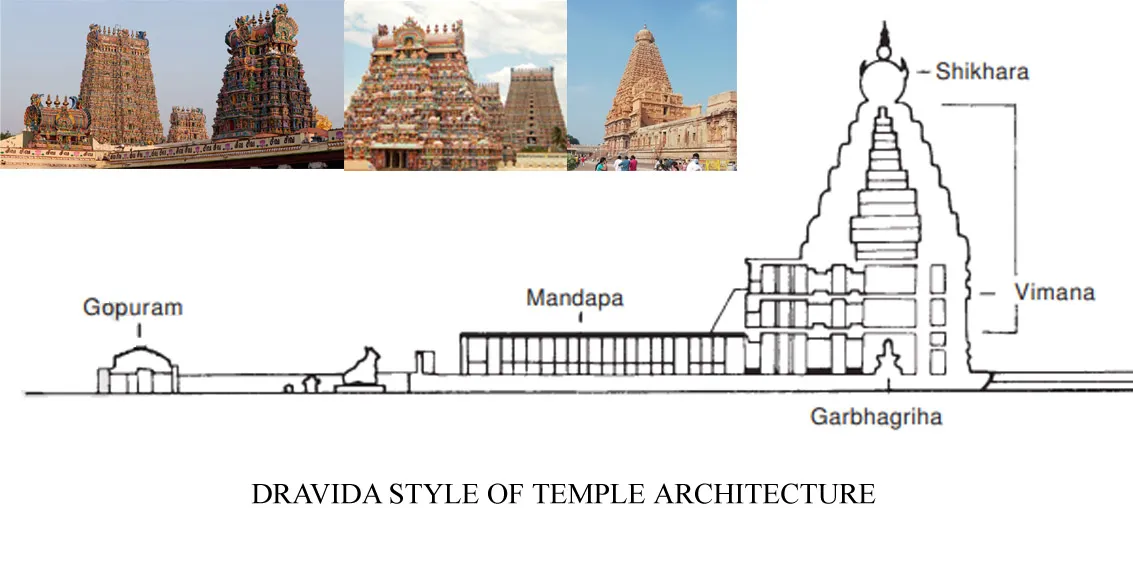
Distinctive Features
- Gopurams
(Gateway Towers):
- Towering
pyramidal structures marking temple entrances
- Example:
The 72m tall Rajagopuram of Sri Ranganathaswamy Temple, Srirangam
- Vimanas
(Shrine Towers):
- Stepped
pyramidal towers over the sanctum
- Brihadeeswarar
Temple's vimana rises 66m, built from a single granite block
- Mandapas
(Pillared Halls):
- Thousand-pillared
halls for rituals and gatherings
- Meenakshi
Temple's Pudhu Mandapa has 985 pillars
- Prakarams
(Concentric Enclosures):
- Multiple
rectangular walled enclosures
- Sri
Ekambareswarar Temple in Kanchipuram has five prakarams
Notable Examples
- Shore
Temple, Mahabalipuram (8th century): One
of the earliest structural temples
- Brihadeeswarar
Temple, Thanjavur (1010 CE): Chola
masterpiece with 80-ton capstone
- Meenakshi
Temple, Madurai (16th century): Complex with
14 gopurams
Chalukyan Temple Architecture

Historical Background
The Chalukyas developed their style in three phases:
- Badami
Chalukyas (6th–8th century CE): Cave temples
and early structural experiments
- Western
Chalukyas (10th–12th century CE): Refined the
Vesara (mixed) style
- Eastern
Chalukyas (7th–12th century CE): Blended with
local Andhra traditions
Characteristic Elements
- Vesara
Style:
- Fusion
of Nagara and Dravida elements
- Curvilinear
shikhara with Dravidian base
- Star-Shaped
Platforms:
- Complex
geometric plans (6, 12, or 32-pointed stars)
- Durga
Temple at Aihole has an apsidal plan
- Ornate
Pillars:
- Lathe-turned
pillars with intricate carvings
- Virupaksha
Temple's pillars depict scenes from epics
- Ceiling
Panels:
- Elaborately
carved lotus designs
- Badami
Cave Temple's ceiling shows Vishnu on Shesha
Important Temples
- Cave
Temples of Badami (6th century): Four
rock-cut shrines
- Virupaksha
Temple, Pattadakal (8th century): UNESCO World
Heritage Site
- Durga
Temple, Aihole (7th century): Unique
apsidal design
- Kashi
Vishwanath Temple, Pattadakal: Perfect
Nagara-Dravida synthesis
Comparative Analysis
|
Feature |
Dravidian Style |
Chalukyan Style |
|
Origin |
Tamil Nadu region |
Karnataka region |
|
Tower Shape |
Pyramidal vimana |
Curvilinear shikhara |
|
Plan |
Rectangular complex |
Stellate (star-shaped) |
|
Material |
Granite predominant |
Sandstone and soapstone |
|
Sculptures |
Divine figures |
Secular scenes included |
Enduring Legacy and Contemporary
Relevance
- Engineering
Marvels:
- Brihadeeswarar
Temple's shadow never falls on the ground due to precise geometry
- Chalukyan
temples demonstrate early seismic-resistant designs
- Cultural
Continuity:
- Kanaka
Durga Temple continues Dravidian traditions in Andhra Pradesh
- Annual
Pattadakal Dance Festival celebrates Chalukyan heritage
- Conservation
Challenges:
- Acid
rain affecting Hoysala temples (UNESCO sites)
- Structural
monitoring of Brihadeeswarar Temple's foundation
Conclusion
The Dravidian and Chalukyan temple architectures
represent India's architectural genius at its peak. From the towering gopurams
of Tamil Nadu to the sculpted marvels of Karnataka, these styles showcase the
diversity and sophistication of ancient Indian craftsmanship. As living
monuments like the Kanaka Durga Temple continue to serve devotees, they remind
us of the need to preserve this invaluable heritage through scientific
conservation and cultural appreciation. These temples are not merely stone
structures but repositories of our collective memory and identity.
Comments
Post a Comment