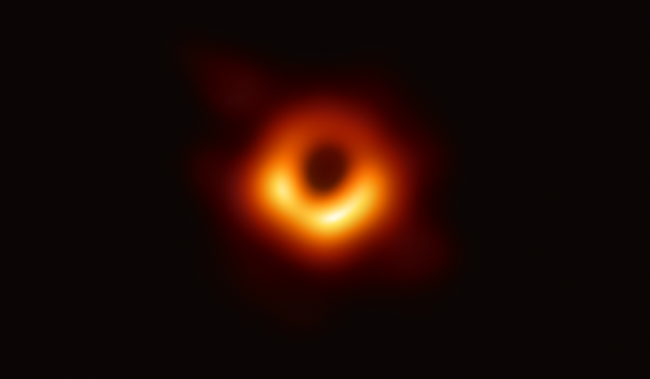
The first image of a black hole in human history, captured by the Event Horizon Telescope, showing light emitted by matter as it swirls under the influence of intense gravity. This black hole is 6.5 billion times the mass of the Sun and resides at the center of the galaxy M87.
Introduction
In July 2024, astronomers observed a groundbreaking cosmic event — a massive black hole merger named GW231123. This event involved the collision of two exceptionally large black holes, one with 137 times the mass of the Sun and the other with 103 solar masses. The resulting merger formed a black hole larger than most previously known. Detected by observatories LIGO (USA), Virgo (Italy), and KAGRA (Japan), this discovery not only confirmed the existence of such high-mass black hole pairs but also raised new questions about their formation, especially since both were found to be rapidly spinning before the merger.
What Are Black Holes?
A black hole is a region in space where gravity is so powerful that nothing—not even light—can escape. This extreme gravitational field is created when matter is compressed into an incredibly small volume. The outer boundary of a black hole is called the event horizon. Once matter crosses this boundary, it is lost to the universe forever. Despite their invisibility, black holes affect nearby matter and emit X-rays and gravitational waves through their interactions.
Additional Facts
-
Sagittarius A* is the supermassive black hole at the center of the Milky Way.
-
The closest black hole to Earth is Gaia-BH1, located approximately 1,560 light-years away.
-
Our galaxy, the Milky Way, is believed to contain up to 100 million black holes.
-
Black holes have multiple components: an event horizon and a central singularity where matter is infinitely dense.
-
Dark matter, though invisible, may influence black hole formation. It is a mysterious form of matter that does not emit or interact with electromagnetic radiation, making it detectable only through its gravitational effects.
Discovery and Origins
-
Predicted by Albert Einstein in 1915 via his general theory of relativity.
-
Karl Schwarzschild found the first exact black hole solution.
-
Term "black hole" was coined by John Wheeler in 1967.
-
First black hole discovered: Cygnus X-1 (1971), confirmed through X-ray observations.
-
Astronomers believe about 1 in every 1,000 stars ends as a black hole.
-
NASA estimates the Milky Way may host 10 million to a billion stellar black holes.
-
In 2019, the Event Horizon Telescope (EHT) released the first image of a black hole in galaxy M87.
-
In 2021, astronomers used polarized light to reveal magnetic fields around M87’s black hole.
-
In 2022, the EHT captured the first image of Sagittarius A*.
Types of Black Holes
Stellar-Mass Black Holes
Formed from the collapse of massive stars (greater than 20 solar masses) after they exhaust their nuclear fuel and explode as supernovae. These are the most common type.
Supermassive Black Holes
Found at the centers of most galaxies, including the Milky Way. They contain hundreds of thousands to billions of solar masses. Theories suggest they form from the merging of smaller black holes, direct gas cloud collapse, or dense star cluster collisions.
Intermediate-Mass Black Holes
These range from 100 to 10,000 solar masses. Confirmed in 2019 during event GW190521, where two stellar black holes merged to form one with 142 solar masses.
Formation of Black Holes
Stellar Collapse
Stars with masses above 8–10 times that of the Sun explode as supernovae. If the remaining core is above ~3 solar masses, it collapses into a black hole.
Direct Gas Collapse
In this case, massive gas clouds collapse directly to form large black holes of 1,000–100,000 solar masses.
Features and Mysteries of Black Holes
Accretion Disks and Jets
Matter falling toward a black hole forms an accretion disk, a rapidly spinning disk of superheated gas and dust. These disks emit X-rays, radio waves, and sometimes visible light. Supermassive black holes can eject material as jets moving near the speed of light, spanning hundreds of thousands of light-years.
Wormholes and Speculative Theories
Some speculative theories suggest black holes might contain wormholes — tunnels connecting two points in spacetime. However, no observational evidence supports this. Wormholes remain a mathematical possibility, while black holes are well-documented astrophysical objects.
Gravitational Waves and Black Hole Mergers
Gravitational waves are ripples in the fabric of spacetime caused by massive cosmic events such as black hole mergers. First detected in 2015 during event GW150914, they opened a new way to study the universe.
-
Two black holes orbit each other and emit gravitational waves.
-
They spiral closer together, losing energy.
-
Eventually, they collide and merge, releasing a powerful gravitational wave burst.
-
GW231123, observed in 2024, involved massive, fast-spinning black holes, suggesting complex formation histories like hierarchical mergers.
Space Probes and Gravity Assists
Observing distant black holes often requires reaching the far edges of the solar system. Space probes like Voyager 2 and Galileo used gravity assists — slingshot maneuvers using planetary gravity — to gain speed and change trajectory. These techniques are crucial for:
-
Extending mission lifetimes.
-
Enabling exploration of high-energy environments around black holes.
-
Carrying instruments that detect X-rays, radio emissions, and gamma rays from active galactic nuclei.
Do Black Holes Die?
Black holes don’t die traditionally but are predicted to evaporate over time through Hawking Radiation. According to quantum theory:
-
Particle-antiparticle pairs pop in and out of existence near the event horizon.
-
One falls in, while the other escapes.
-
This causes the black hole to lose a tiny amount of energy.
-
Over trillions of years, this results in gradual shrinkage and eventual disappearance.
Conclusion
Black holes were once a mathematical curiosity, but they now sit at the heart of astrophysical research. Through gravitational waves, radio imaging, and X-ray emissions, we are uncovering the secrets of their formation, growth, and role in the evolution of the universe. Discoveries like GW231123 offer a glimpse into cosmic extremes, pushing the boundaries of human understanding and technology. As tools improve, black holes will continue to reveal more about the fundamental forces shaping our universe.
Comments
Post a Comment